
ATEX UT Inspection in Refineries
How to Digitize UT Thickness Measurements in Hazardous Areas


However, ATEX environments often slow down this transformation. In many facilities, UT thickness measurements in Zone 0, 1, or 2 are still recorded on paper or spreadsheets before being transferred into an Asset Integrity Management (AIM) or Inspection Data Management System (IDMS). The reason is not a lack of technology. It is compliance. In hazardous areas, every device used in the field must be suitable for explosive atmospheres. While UT gauges are typically ATEX-certified, the digital workflow around the measurement often is not. Mobile devices, data capture tools, and connectivity solutions must also comply with ATEX requirements. For inspection leaders in refineries and chemical plants, the challenge is therefore clear: how can UT inspections become digital while remaining fully ATEX compliant?
ATEX Compliance and Digital UT Inspections
ATEX regulations define how equipment and work processes must be handled in explosive atmospheres.
Fact note
The ATEX Product Directive (2014/34/EU) regulates equipment intended for use in hazardous environments, while the ATEX Workplace Directive (1999/92/EC) requires operators to classify hazardous areas and ensure that appropriate equipment is used in each zone.
For inspection teams performing UT thickness measurements in refineries, this means that the entire inspection workflow must be compatible with the classified zone. If the UT instrument is certified but the mobile device used to record readings is not, the process can become non-compliant. This is one of the main reasons why many ATEX UT inspection workflows remain partially manual today.
The Hidden Cost of Manual UT Data Capture
Most operators already manage inspection programs through AIM or IDMS platforms. These systems store component data, corrosion circuits, and measurement locations such as CMLs or TMLs.
Yet the field data capture step is often still manual. Inspectors frequently write readings down or transfer values into spreadsheets before uploading them later. These additional steps introduce delays and increase the risk of transcription errors or incorrect measurement mapping. In many inspection programs, a substantial portion of the time spent on UT inspections is consumed by manual data capture and data transfer. At the same time, reporting errors caused by manual transcription are not uncommon. For inspection leaders responsible for data integrity, this creates both operational inefficiencies and potential compliance risks.
Building a Digital ATEX UT Inspection Workflow
Digitizing UT inspections in hazardous areas requires more than replacing paper with an app. The entire workflow must support ATEX conditions.
First, the UT instrument itself must be suitable for the zone classification. Many refineries already use intrinsically safe gauges designed for explosive environments. Second, inspectors need ATEX-certified mobile devices that can safely operate in the same area. Finally, a software layer must connect the inspection instrument to the digital inspection system so that measurement data can be captured automatically and transferred without manual re-entry. When these elements are combined, UT thickness measurements can be captured directly at the inspection point and linked to the correct component or measurement location.
The DIMATE UT-Gateway Approach
The DIMATE UT-Gateway App was developed to enable digital UT thickness measurement workflows in ATEX environments.
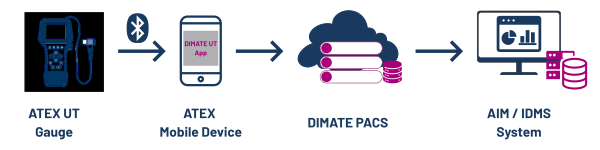
Running on ATEX-compliant mobile devices, the app connects via Bluetooth to supported UT thickness gauges and captures measurement values digitally. Instead of manually recording readings, inspectors can immediately associate them with the correct component, work order, and CML or TML location.
The inspection data is then transmitted through DIMATE PACS into the organization’s AIM or IDMS platform. This creates a seamless connection between the inspection point in the refinery and the digital inspection system. Because measurements and contextual data are captured together, the workflow significantly reduces manual re-entry while improving traceability.
Benefits for Refinery Inspection Teams
For inspection leaders responsible for UT inspection programs, a connected digital workflow delivers clear advantages.
Fact note
Inspection teams typically see 30-40 % faster data capture and transfer compared to manual workflows. At the same time, eliminating manual transcription significantly reduces reporting errors and improves data reliability.
Digital UT inspection workflows also strengthen auditability. Measurements are automatically linked to the correct component and inspection activity, creating a consistent and transparent inspection record. In environments where safety, compliance, and asset integrity are critical, this level of traceability is essential.
True digital maturity starts at the measurement point. Yet in ATEX zones, data is still captured manually and only later transferred into digital systems. Bridging this gap is the next step in modern inspection

A Practical Path Toward Digital UT Inspections
Inspection leaders planning to modernize UT inspection programs should start by reviewing how measurements are currently captured in the field.
If readings are still recorded manually before entering the inspection system, this step represents the greatest opportunity for improvement. By combining ATEX-compliant instruments, certified mobile devices, and connected inspection software, refineries can create a seamless digital UT thickness measurement workflow from the inspection point to the inspection database.
Safer, Faster, and Smarter UT Inspections in ATEX Areas
Digitalization and ATEX compliance do not have to conflict. With the right combination of certified inspection equipment, ATEX-ready mobile devices, and integrated inspection software, UT thickness measurements in hazardous refinery environments can be captured and transferred digitally. For inspection teams, this means faster reporting, improved data quality, and better transparency across the entire inspection process.
Talk to an expert
Take the next step and discover how a digital ATEX UT workflow can fit into your inspection program with a tailored demo of the DIMATE UT-Gateway App.
Florian Anke
DIMATE
